
design
LICE, the Language Incorrectly Called English
It turns out the language you're reading isn’t really English.
Even more suprising than English not being English is how easy it is to demonstrate that English isn’t really English.
The story goes that the Germanic peoples who invaded Britain after the Romans withdrew created the West Germanic language known as English. English took its name from the group that proved the most linguistically influential, who were the Angles.
Here’s the problem:
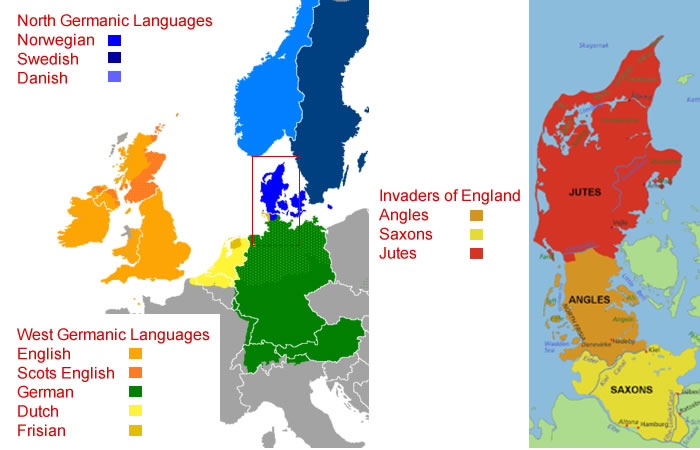
Two of the three originators of the West Germanic language called English, including the one it was named for, spoke North Germanic.
So either English is really a North Germanic language, or it did not develop from the language spoken by the Angles--in which case, it shouldn’t be called English.
We can rule out the first option fairly safely. Despite frequent Danish invasions through 1066 (not to mention the Norman addition of Old French from that year on), English today is classed as one of the Anglo-Frisian group of West Germanic languages.
Frisians, as well as Jutes, joined the Angles and Saxons in invading England. Frisian, importantly perhaps, was a kind of North Sea lingua franca.
“A thousand years or so ago Frisian was apparently spoken throughout a North Sea coastal area extending from the modern Netherlands province of Noord-Holland (North Holland) on up to modern German Schleswig and the adjacent offshore islands.” http://www.britannica.com/EBchecked/topic/640154/West-Germanic-languages
The real story of English may be that the Angles, Saxons and Jutes, as well as Frisians, came to settle on some version of simplified Frisian as the best medium of communication. This simplified Frisian developed into LICE, the Language Incorrectly Called English.
There is at least one alternate explanation.
While the Saxons lived in Schelswig-Holstein at the edge of the North Germanic area, they spoke a West Germanic language. Wessex, or the kingdom of the West Saxons, dominated England in the tenth and eleventh centuries. It’s possible that their language developed into LICE.
The truth may well be a bit of both:
"The early Anglo-Frisian and Old Saxon speech communities lived close enough together to form a linguistic crossroads." http://en.wikipedia.org/wiki/Anglo-Frisian_languages The phrase "linguistic crossroads" is to my mind a poor translation of the original Sprachbund. Sprachbund, consisting of the English cognates "speech" and "bound," conveys much better, I think, the idea of two languages melded together.
Frisian and Saxon may have been so closely related, so scarcely distinguishable, that it will never be possible to determine which one, or exactly what combination of the two, developed into modern English.
So LICE may not be Frisian after all. It may be Saxon or Saxo-Frisian.
But in any case, what it’s not is English.